Innovative
Cutting-edge Technology

Snoring is treated as a joke in most households, and usually it is harmless. What far fewer people know is that a particular kind of snoring signals a condition that strains the heart every night.
So here is the practical version.
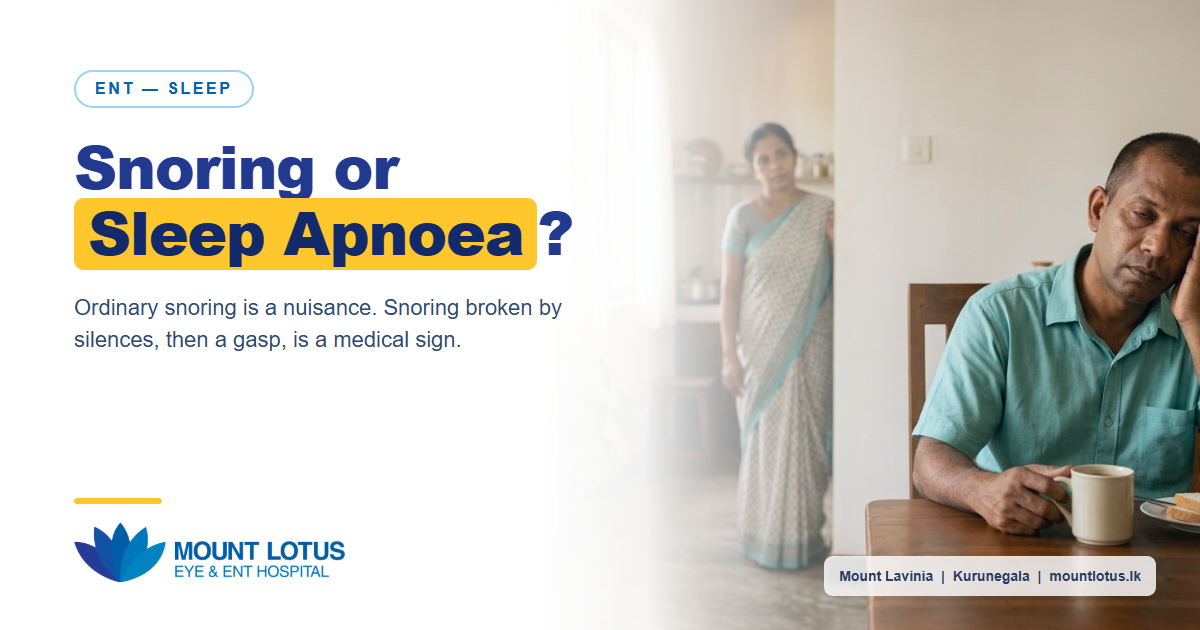
Snoring is the sound of air forcing its way past soft tissue that has relaxed during sleep. On its own, it is a noise problem.
Sleep apnoea is different. Here the airway does not just narrow, it closes completely. Breathing stops, oxygen levels fall, and the brain briefly wakes the body to restart it. This can repeat dozens of times an hour, all night, without the person ever remembering waking.
As a result, someone with sleep apnoea can spend eight hours in bed and still wake exhausted.
The person with sleep apnoea is rarely the one who spots it. Take these seriously if someone reports them:
Daytime sleepiness is the one most often dismissed. However, it is the symptom with the clearest safety consequences.
Every time breathing stops, oxygen drops and the body releases stress hormones to restart it. Repeated nightly over years, that pattern is linked to high blood pressure, heart rhythm problems, stroke and poorly controlled diabetes.
There is also the immediate risk. Untreated sleep apnoea significantly raises the chance of a road accident, because the sleepiness it causes is not the ordinary kind that coffee fixes.
Neither point is a reason to panic. Instead, both are reasons to have it assessed rather than to keep joking about it.
Several things narrow the airway, and often more than one applies:
Weight. Extra tissue around the neck narrows the airway during sleep. Weight loss genuinely helps.
Nasal blockage. A deviated septum, chronic sinusitis or persistent allergy forces mouth breathing, which worsens collapse.
Large tonsils or adenoids. In children this is the most common cause by a wide margin, and treating it can transform their sleep.
Jaw and airway shape. Some people are simply built with a narrower airway.
Alcohol and sedatives at night. Both relax the airway muscles further.
An ENT examination identifies which of these apply to you, since the nose and throat contributors are often treatable in their own right.
An ENT consultation begins with your history, including what your partner has observed. The nose, throat and palate are then examined to find where the airway is narrowing.
Depending on what is found, a sleep study may be arranged to measure how often breathing stops and how far oxygen falls. That test is what confirms sleep apnoea and grades its severity.
Treatment follows the cause. It may involve weight management, treating nasal obstruction, a CPAP machine that holds the airway open overnight, or surgery where a specific structural problem is responsible.
A child who snores every night, sleeps restlessly, breathes through their mouth, or is unusually irritable and inattentive at school deserves an ENT opinion.
In children, enlarged tonsils and adenoids are usually responsible, and the results of treating them are often dramatic. In fact, parents frequently report a different child afterwards.
Ordinary snoring is a nuisance. Snoring punctuated by silences, followed by gasping, is a medical sign.
If your partner has described you stopping breathing, or if you are sleeping a full night and still exhausted through the day, have it looked at. The assessment is straightforward, and the conditions behind it are treatable.
Mount Lotus Eye & ENT Hospital — Mount Lavinia & Kurunegala. ENT consultants and audiology services, open daily 7am–8pm.
📞 Mount Lavinia: 0112 333 444 | Kurunegala: 0372 333 444