Innovative
Cutting-edge Technology

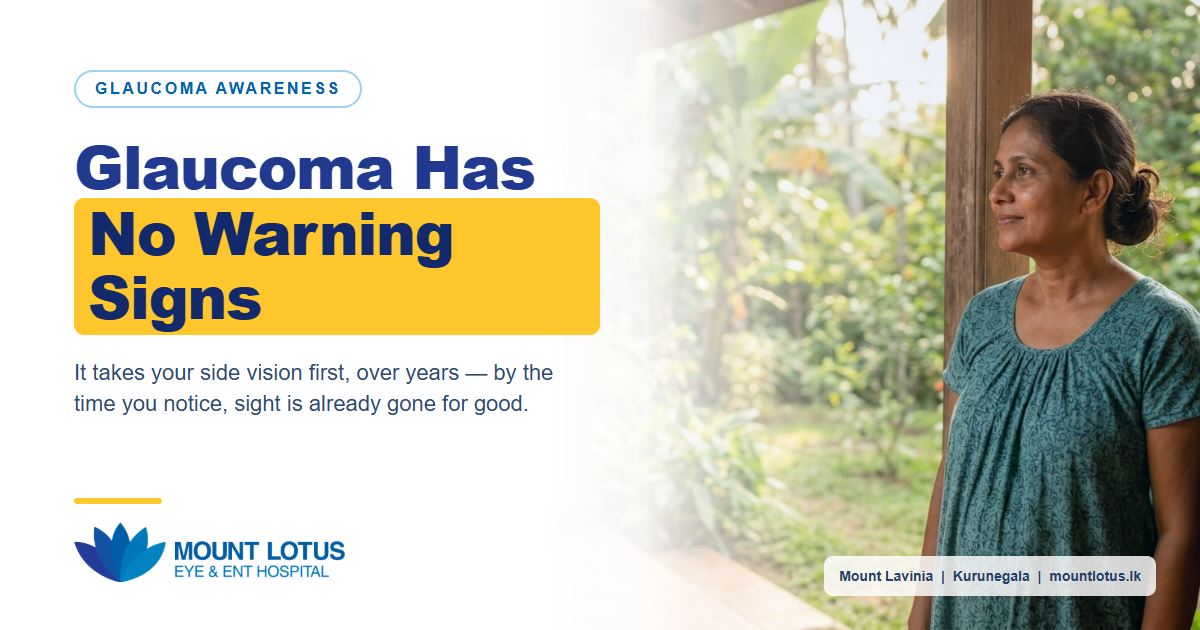
Most eye problems announce themselves. Vision blurs, colours fade, something hurts. Glaucoma does none of that — and that is exactly what makes it dangerous.
By the time most people notice a problem, a significant amount of sight has already been lost permanently.
Inside your eye, fluid is constantly produced and drained. When drainage slows, pressure builds. That pressure gradually damages the optic nerve — the cable carrying images from your eye to your brain.
Once optic nerve fibres are lost, they do not grow back. This is the single most important thing to understand about glaucoma: treatment protects the vision you still have, but it cannot recover what is gone.
Glaucoma takes your peripheral vision first — the edges, not the centre. Your brain is very good at filling in the gaps, and your other eye compensates for the one that is affected.
So you keep reading, driving and recognising faces normally. Meanwhile the loss creeps inward over years, and central vision is affected only in the late stages.
This is why glaucoma is often called the silent thief of sight.
Get your eye pressure checked if you are:
If none of these apply, a check every two years after 40 is sensible. However, if any do, make it yearly.
A glaucoma screening is quick and painless. There is no needle and no injection.
The whole assessment usually takes under an hour.
Treatment aims to lower eye pressure and hold it steady.
Eye drops are usually the first step. They work well, but only if used every single day, indefinitely. As a result, many people find this difficult to sustain over years.
SLT laser (selective laser trabeculoplasty) is a short outpatient procedure that improves the eye’s natural drainage. It takes a few minutes, requires no cutting, and for many patients reduces or removes the need for daily drops. Mount Lotus was the first hospital in Sri Lanka to offer SLT.
Surgery is reserved for cases where pressure remains high despite drops and laser.
Which approach suits you depends on the type and stage of glaucoma — that decision comes after the assessment, not before.
Glaucoma cannot be reversed, but it can almost always be controlled if it is found early. In fact, the only way to find it early is to be tested before you have symptoms.
If you are over 40, or anyone in your family has glaucoma, book an eye pressure check. It takes an hour, and it is the only reliable protection you have.
Mount Lotus Eye & ENT Hospital — Mount Lavinia & Kurunegala. Open daily 7am–8pm.
📞 Mount Lavinia: 0112 333 444 | Kurunegala: 0372 333 444