Innovative
Cutting-edge Technology

Being told you need treatment for diabetic retinopathy is unsettling, mostly because nobody explains what the treatment is for. People picture something that will restore their sight, and are then disappointed by a result that was never the goal.
So here is the practical version, starting with the part that matters most.
This is the single most important thing to understand, and the thing most often missed.
Diabetic retinopathy treatment is given to stop further loss. It is not given to bring back vision that has already gone. Retinal tissue that has been starved or scarred does not recover, and no treatment currently available changes that.
That sounds discouraging. It is the opposite. It means the value of treatment depends almost entirely on how early it starts — which is why the yearly eye examination is pressed so hard on people who feel perfectly fine. The same principle governs glaucoma, and for the same reason.
Treated early, most people keep useful sight. Treated late, the work is salvage.
Retinal laser — photocoagulation — is the mainstay. It does not cut or remove anything. It places small, precise burns on the retina, and those burns do one of two jobs depending on the problem.
Sealing leaks. Where damaged vessels are leaking fluid, laser applied around the leaking area reduces the leakage and the swelling it causes.
Switching off the demand for new vessels. Where patches of retina have lost their blood supply, those starved patches send out a chemical signal that drives the eye to grow fragile new vessels — the ones that bleed and pull. Laser treats the starved peripheral retina so it stops sending that signal. The eye gives up building the dangerous vessels.
The second is the counterintuitive one. The laser deliberately treats peripheral retina that is already damaged, trading a small amount of side vision to protect the central vision you read and recognise faces with. That trade is the whole point, and it is why some people notice their night vision or peripheral vision is not quite what it was afterwards.
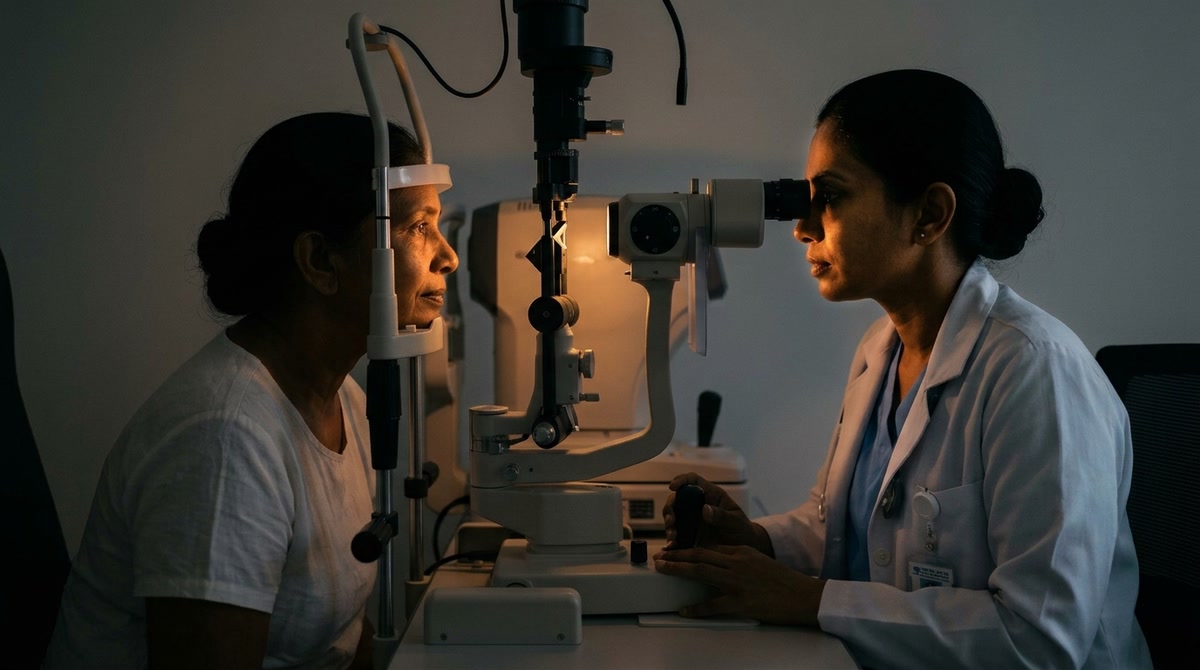
Laser is an outpatient procedure. Drops widen the pupil and numb the surface of the eye, a contact lens is placed on the eye to focus the beam, and you sit at a machine much like the one used to examine you.
You see bright flashes. The eye may ache afterwards and vision is blurred for a few hours from the drops, so arrange not to drive yourself home.
Treatment is often split across more than one session rather than done all at once, and more may be needed later — not because the first attempt failed, but because diabetes is ongoing and the retina keeps being asked to cope with it.
Laser works on a retina the surgeon can see and that is still in place. Surgery becomes the answer when one of those stops being true.
Bleeding that will not clear. When fragile new vessels bleed into the gel that fills the eye, the view is blocked — for you and for the surgeon. Small bleeds settle on their own. Ones that do not need the gel removed, which is a vitrectomy.
The retina being pulled. As new vessels contract they drag on the retina and can lift it off the back of the eye. That needs surgery to release the traction and get the retina flat again.
This is vitreoretinal surgery, and it is a different undertaking from cataract surgery — longer, and recovery measured in weeks rather than days. It is also the stage everything earlier is designed to avoid.
Laser and surgery deal with damage that has already happened. Neither treats the cause.
Blood sugar, blood pressure and cholesterol continue to decide how fast the retina is damaged after treatment as much as before it. People sometimes read a completed laser course as the end of the matter. It is not — it is a repair, and the thing that caused the damage is still running.
Follow-up is part of the treatment, not an optional extra. Retinopathy that has needed treatment once is retinopathy that needs watching.
Diabetic retinopathy treatment is about holding the line. Laser stops leakage and shuts down the signal that produces dangerous new vessels; surgery steps in when there is blood that will not clear or a retina being pulled out of place. Neither gives back what has gone.
Everything therefore depends on starting early, and starting early depends on being examined while your sight still seems fine.
If you live with diabetes, book an eye examination at Mount Lotus Eye & ENT Hospital — Mount Lavinia or Kurunegala.
📞 Mount Lavinia: 0112 333 444 | Kurunegala: 0372 333 444


Specialist eye, ear, nose and throat care is coming to the Uva Province — the same care that families in Mount Lavinia and Kurunegala already trust, now in your own town.