Innovative
Cutting-edge Technology

Nearly every red eye gets the same treatment at home — a pharmacy drop and a few days’ patience. Most of the time that is fine. What almost nobody is told is how to spot the small number that are not fine, and those are the ones that cost vision.
So here is the practical version.
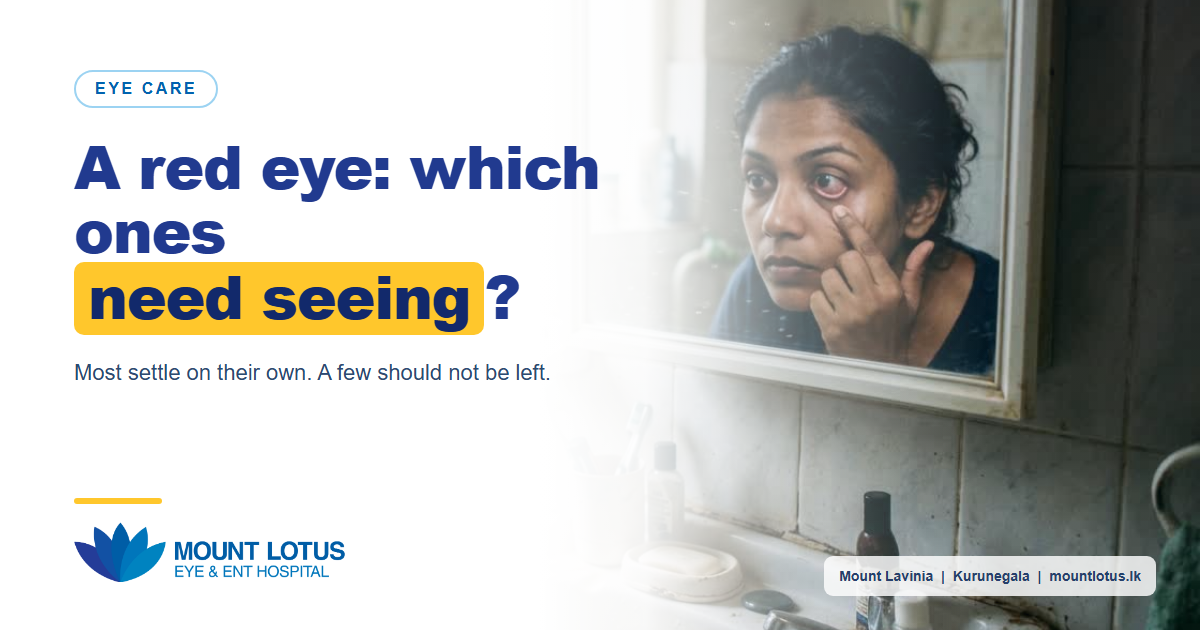
The white of the eye reddens whenever its surface blood vessels widen. Dust, smoke, a late night, a swimming pool, an allergy or an infection will all do it.
So redness on its own is not the useful signal. What matters is the company it keeps: pain, vision change, light sensitivity and the shape of the pupil. Those are what separate an irritated eye from a threatened one.
Treat a red eye as urgent if any of these are present:
Contact lens wearers deserve a lower threshold than everyone else. A red, painful eye in a lens wearer can be a corneal infection, and those move quickly.
For a chemical splash, do not wait for anything: rinse the eye with clean running water for fifteen to twenty minutes, then go straight to eye casualty.
Conjunctivitis. Redness across the whole white of the eye, gritty rather than painful, often with discharge and frequently both eyes. Viral cases settle on their own; hygiene matters because it spreads easily.
Allergy. Itching is the giveaway — allergic eyes itch in a way infected eyes do not. Often seasonal, usually both eyes, often with sneezing.
Dry eye. Burning, fluctuating vision that clears on blinking, worse with screens, air conditioning and fans.
A subconjunctival haemorrhage. A dramatic patch of solid red, like a bruise on the white of the eye. It looks alarming and is usually harmless, with no pain and no vision change. It clears over a couple of weeks.
Tiredness, smoke or dust. Ordinary, and settles with rest and time.
Redness-relief drops work by narrowing the blood vessels. They do not treat a cause, and used regularly they produce rebound redness that is worse than the original.
More importantly, steroid drops used without an examination can turn a herpes infection of the cornea into a serious one, and can raise eye pressure. That is why a red eye that is painful or affecting vision should be examined before anything is put into it.
If a drop has been prescribed for you before, that does not make it right for the next red eye. Different causes, different treatments.
An eye examination for a red eye is quick and painless. Vision is measured first, then the eye is examined at the slit lamp under magnification.
A drop of orange dye is often used: it shows up scratches or ulcers on the cornea under blue light, which is how a minor abrasion is separated from an infection. Eye pressure is measured where the picture suggests it matters.
Most people leave with a clear cause and the right treatment within half an hour.
A red, gritty, itchy eye with normal vision and no real pain can usually wait, and often needs nothing.
A red eye with pain, reduced vision, light sensitivity or an odd-looking pupil should be seen the same day — and so should any red eye in a contact lens wearer. In fact, those four questions are the whole triage: does it hurt, can you see, does light bother you, and does the pupil look right.
Mount Lotus Eye & ENT Hospital — Mount Lavinia & Kurunegala. Eye casualty and consultant eye surgeons, open daily 7am–8pm.
📞 Mount Lavinia: 0112 333 444 | Kurunegala: 0372 333 444


Specialist eye, ear, nose and throat care is coming to the Uva Province — the same care that families in Mount Lavinia and Kurunegala already trust, now in your own town.