Innovative
Cutting-edge Technology
Choosing where to have cataract surgery in Sri Lanka matters just as much as choosing when. It is your eye, your one pair — and the difference between an average experience and an excellent one comes down to the surgeons, the technology, and how the hospital treats you between the first assessment and the final follow-up.
If you are weighing up the best eye hospital for cataract surgery, these are the things worth comparing. Here is what patients tell us made the difference when they chose Mount Lotus Eye & ENT Hospital.
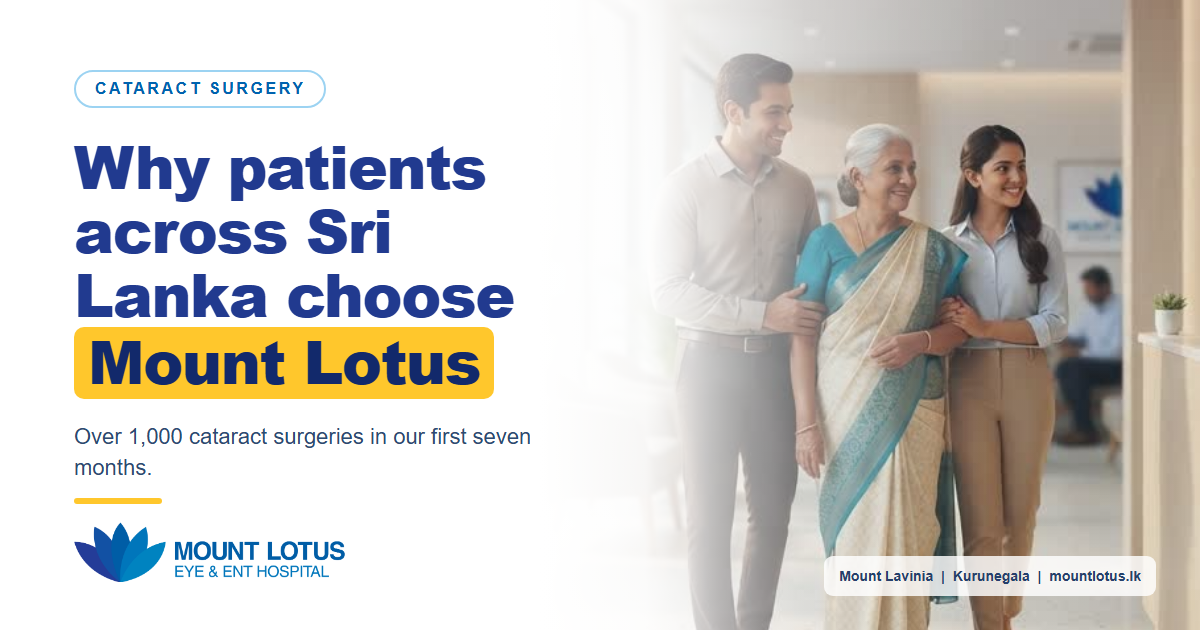
Repetition builds surgical skill. Our surgeons completed over 1,000 cataract surgeries within the hospital’s first seven months — the kind of volume that builds deep, current expertise not just in routine cases but in the complex ones: dense mature cataracts, patients with diabetes, previous eye conditions, and very elderly patients.
Why does volume matter to you personally? Because experienced surgical teams run quieter operating rooms, finish faster, and answer rare situations calmly. When a surgeon has seen your kind of eye many hundreds of times, you are not an experiment — you are Tuesday morning.
Mount Lotus performs phacoemulsification, the modern global standard. Gentle ultrasound breaks up the cloudy lens and removes it through an incision of roughly 2–3 millimeters. That tiny opening typically seals itself, which means:
Your surgeon then places a clear artificial lens (an intraocular lens, or IOL) where your natural lens used to sit, and it stays there for life. During your assessment we measure your eye precisely and walk you through the lens options — from standard high-quality lenses to premium designs that can reduce your dependence on glasses. If the procedure itself worries you, read our plain-language guide to how safe cataract surgery really is.
Mount Lotus is not a general hospital with an eye unit somewhere on the third floor. We are a dedicated Eye & ENT hospital, so the operating theaters, diagnostic equipment, nursing skills and even the front-desk workflows all serve patients like you. If you are deciding what to look for in an eye hospital, that is the difference: at a specialist eye hospital your ophthalmologist works in a theatre built only for eyes, rather than one shared with every other department.
That focus shows in small things that add up: staff who answer cataract questions accurately at the reception desk, theater teams who do this every day, and follow-up scheduling that matches how eyes actually heal.
We run full-service hospitals in Mount Lavinia and Kurunegala, with complete cataract services at both — assessment, scans, surgery, and every follow-up visit. Patients from Colombo’s southern suburbs and the North Western Province alike get the same surgeons’ standard of care without long-distance travel for each appointment.
For elderly patients especially, having the full journey close to home matters: less travel fatigue, easier attendance at follow-ups, and family nearby.
Cataract surgery involves decisions — lens types, timing, cataract surgery cost in Sri Lanka, insurance. Patients consistently tell us they valued something simple most: we explain things before asking you to decide.
If you are comparing cataract operation cost in Sri Lanka between hospitals, ask what each quoted figure actually includes — the tests, the lens itself, and the follow-up visits. That is where quotes differ most.
No surprises on surgery day, and no surprises after it.
If you also live with diabetes, pair this with your yearly diabetic eye screening — the two assessments cover different parts of the same eye.
The story we hear most often is not about technology at all. It is about the moment, a day or two after surgery, when someone looks at a leaf, a grandchild’s face or a white wall and realizes how much color and detail the cataract had quietly taken. Restoring that is why our teams do this work.
Every cataract journey at Mount Lotus starts the same way: an honest, unhurried assessment with a consultant eye surgeon. If surgery will genuinely help you, we will say so. If it is safe to wait, we will tell you that too.
Book your cataract assessment at Mount Lotus Eye & ENT Hospital — Mount Lavinia or Kurunegala.
Mount Lavinia: 0112 333 444 | Kurunegala: 0372 333 444

Specialist eye, ear, nose and throat care is coming to the Uva Province — the same care that families in Mount Lavinia and Kurunegala already trust, now in your own town.