Innovative
Cutting-edge Technology

If the phrase “eye surgery” makes your stomach tighten, you are in the majority. Almost every patient who sits down for a consultation asks one question first: is cataract surgery safe? Almost every one of them also pictures something very different from what actually happens in a modern operating theater.
So let us replace imagination with facts. A cataract — ඇසේ සුද in Sinhala — simply means the eye’s natural lens has turned cloudy.
Surgeons perform cataract surgery millions of times every year, on every continent. Few procedures in all of medicine have been refined by this much repetition, studied this thoroughly, or standardized this carefully.
That matters for a simple reason. Safety in surgery is largely a product of practice. A procedure performed daily, by teams who do nothing else, on equipment engineered for exactly this task, sits in a completely different risk category from rare or experimental operations. Success rates are very high, and the overwhelming majority of patients see significantly better afterwards.
At Mount Lotus, our surgeons completed more than 1,000 cataract surgeries in the hospital’s first seven months alone — daily, routine, calm work.
Understanding the procedure removes most of its menace. Here is the whole thing.
1. Your surgeon numbs the eye. Anesthetic drops — occasionally a small injection beside the eye — remove all sensation. The team then cleans and drapes the area, and a gentle device holds your eyelids open. You do not have to worry about blinking.
2. A micro-incision opens the eye. It measures about 2–3 millimeters, smaller than a grain of rice. Everything else happens through that tiny opening.
3. Ultrasound removes the cloudy lens. This step is phacoemulsification, today’s standard. A slim probe uses ultrasound vibrations to break the clouded lens into microscopic fragments, then gently washes and draws them out. No cutting of the lens, no scooping — the imagery most patients carry is decades obsolete.
4. Your new lens goes in. Your surgeon folds a clear intraocular lens, slides it through that same incision, and it unfolds into position where your natural lens used to sit. The cataract lens stays there for life. It cannot wear out, and nobody can see or feel it.
5. The incision seals itself. At this size the cornea closes the opening on its own, so usually there are no stitches at all. From the first drop to the last step: typically 15 to 30 minutes. You wear a protective shield and go home the same day.
These are the two universal fears, so let us address them squarely.
You will not see the surgery. The microscope light fills your vision completely. Patients describe brilliant light, soft colors and gentle movement, and nothing more. Your eye simply cannot present you a sharp image of anything during the procedure.
Small movements are expected. You rest comfortably, the team guides you, and mild sedation is available if you feel anxious. Your cataract surgeon works with a living, breathing patient every single day, so you do not need to perform perfect stillness. In fact, the patients who were most nervous beforehand are usually the most amazed afterwards at how uneventful it felt.
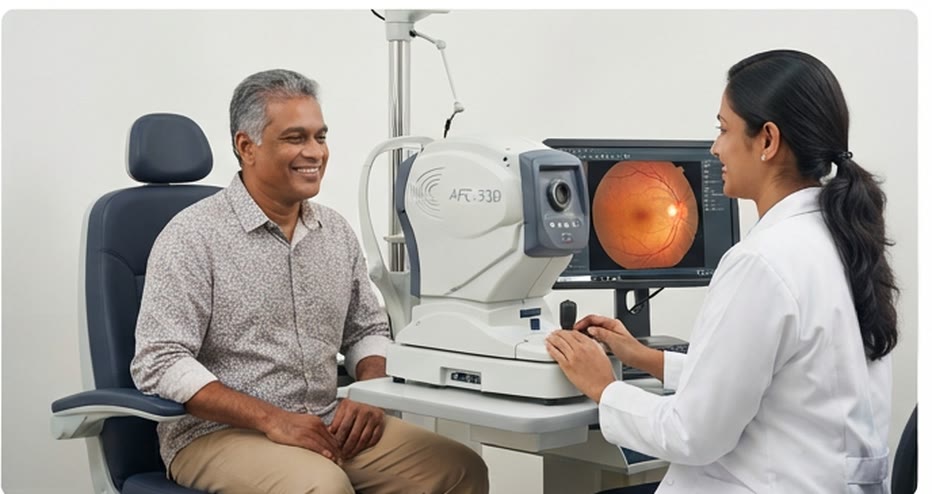
What makes modern cataract surgery safe is not only what happens in the theater. It is everything wrapped around it.
Because of that follow-up, early detection turns rare problems into managed ones.
No genuine surgery carries zero risk, and you should be wary of anyone who claims otherwise. Serious complications — infection, bleeding, retinal problems — remain rare, and your surgeon will discuss them openly before you consent, in plain language and with numbers in context. The NHS guidance on cataract surgery sets out the same picture. We talk about risk not to alarm you, but because informed patients decide confidently and recover with less anxiety.
Here is the context that matters most. For someone whose vision is failing, the greater everyday risk is usually the untreated cataract itself. Falls on stairs, missed steps, night driving with degraded vision, medication labels misread — these risks accumulate quietly every month, while the risk of a twenty-minute refined procedure gets weighed and reweighed. Most patients tell us afterwards that their only regret was waiting. Age on its own is not a barrier either: cataract surgery is safe for elderly patients in Sri Lanka, and a large share of the people we operate on are in their seventies and eighties.
So, what is cataract surgery and how long does recovery take? The operation itself is the short part; this is the timeline that follows it.
Patients ask about cataract surgery cost in Sri Lanka almost as often as they ask about safety. Three things drive it: the type of intraocular lens you choose, whether you treat one eye or both, and the pre-operative tests your eye needs. Because the lens is calculated for your eye specifically, nobody can quote you an accurate figure before that assessment. Ask for the full breakdown at your consultation, and ask what it includes.
Modern cataract surgery is short, refined, essentially painless, and backed by one of the deepest safety records in medicine. In short, the procedure has earned the trust placed in it — millions of times a year.
Meet the team behind 1,000+ surgeries. Book a cataract consultation at Mount Lotus Eye & ENT Hospital and get an honest assessment of exactly where you stand.
Mount Lavinia: 0112 333 444 | Kurunegala: 0372 333 444


Specialist eye, ear, nose and throat care is coming to the Uva Province — the same care that families in Mount Lavinia and Kurunegala already trust, now in your own town.