Innovative
Cutting-edge Technology

Most parents have heard the term lazy eye. Far fewer are told the part that actually matters: that treatment works well in a young child, and barely at all once they are grown.
So here is the practical version.
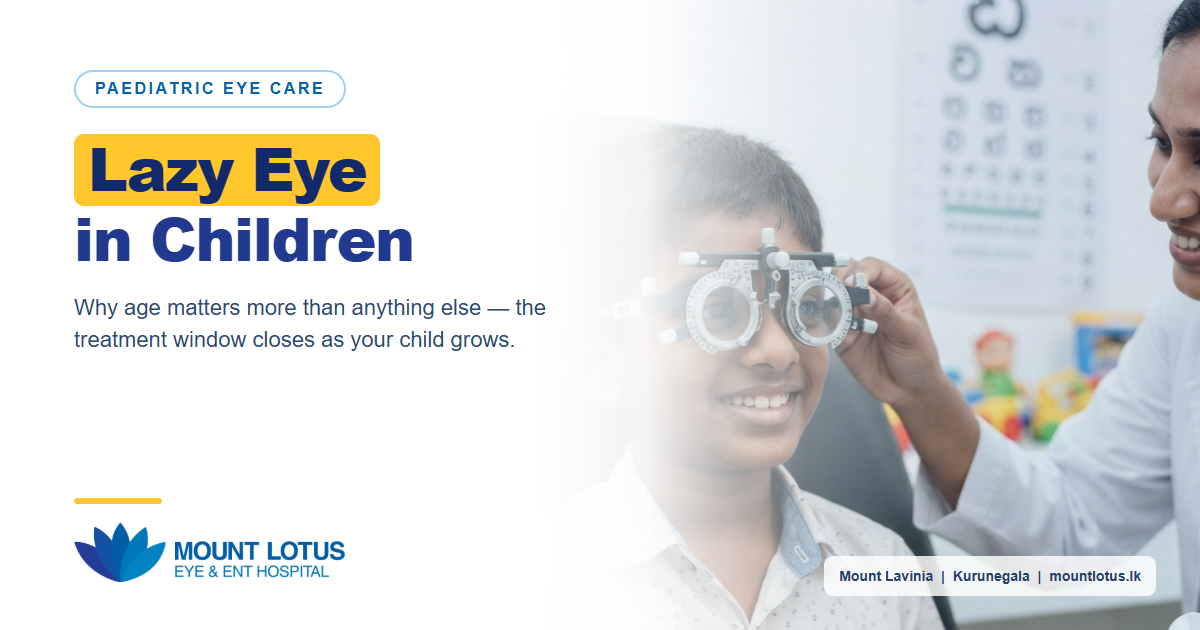
Lazy eye, or amblyopia, is not a problem with the eye itself. It is a problem with the connection between the eye and the brain.
If one eye sends a blurred or confusing image during early childhood, the brain quietly learns to favour the stronger eye. Over time it stops processing the weaker one properly. The eye may be perfectly healthy, yet the vision through it never develops.
Because the good eye compensates so well, the child sees fine overall. As a result, nobody notices anything is wrong.
The visual system develops through early childhood and becomes far less adaptable as a child grows. Treatment works best in the pre-school years, remains useful through early primary school, and becomes progressively harder after that.
This is the single most important fact about amblyopia. A lazy eye found at four is usually very treatable. The same lazy eye found at twelve often is not.
Nothing about the condition announces itself in the meantime. That is precisely why it gets missed.
Three things account for most cases:
The second cause is the most easily missed, because the eyes look completely normal. There is no turn, no squint, nothing visible. Only a proper eye examination finds it.
Book an eye examination if your child:
That second-to-last one is worth remembering. Many parents discover a problem by accident this way.
Treatment has two parts, and both matter.
Correct the cause first. If the child needs glasses, they wear glasses. If a cataract is blocking vision, it is removed. Nothing else works until the eye can deliver a clear image.
Then make the brain use the weaker eye. Traditionally this means patching the stronger eye for a few hours a day. Eye drops that temporarily blur the stronger eye achieve the same effect and suit some children better.
Treatment takes months rather than weeks, and consistency matters more than intensity. Meanwhile, most children adapt to patching far more easily than their parents expect.
Even with no symptoms at all, children should have a proper eye examination:
A children’s eye examination does not require the child to read letters or know the alphabet. Our paediatric team tests vision in toddlers and pre-schoolers routinely, using pictures, shapes and matching games.
A lazy eye causes no pain, no redness and no complaint. The child does not know they are missing anything, because they have never seen any other way.
That silence is exactly why it gets caught late. And unlike most eye problems, this one has a deadline — the treatment window closes as the child grows.
If your child has never had a proper eye examination, arrange one before school rather than waiting for a reason.
Mount Lotus Eye & ENT Hospital — Mount Lavinia & Kurunegala. Paediatric eye surgeons at both hospitals.
📞 Mount Lavinia: 0112 333 444 | Kurunegala: 0372 333 444


Specialist eye, ear, nose and throat care is coming to the Uva Province — the same care that families in Mount Lavinia and Kurunegala already trust, now in your own town.