Innovative
Cutting-edge Technology

Most families are told a squint in children is something they will grow out of. Some do. Many do not, and the waiting itself can cost a child vision that cannot be recovered later.
So here is the practical version.
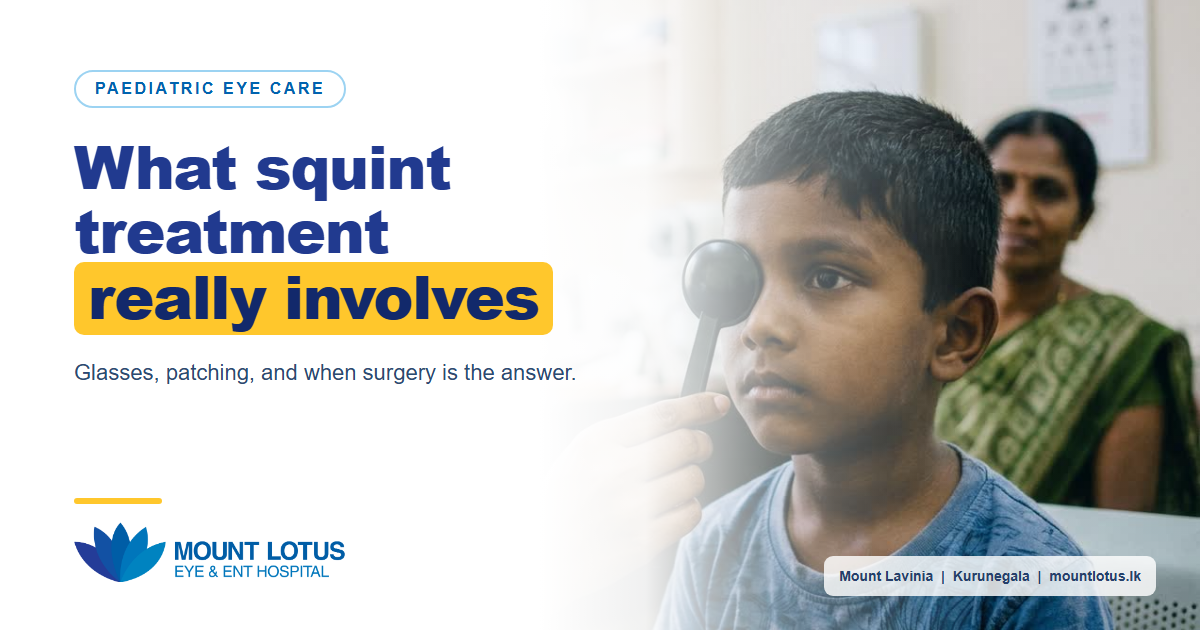
A squint means the two eyes do not point in the same direction. One may turn inward, outward, up or down, either constantly or only when a child is tired or unwell.
Parents usually notice how it looks. The more important problem is invisible: when the eyes point differently, the brain receives two mismatched pictures. To avoid double vision, it learns to ignore one of them.
An ignored eye stops developing. That is amblyopia — lazy eye — and it is the reason a squint is treated early rather than watched indefinitely.
Vision develops through early childhood, and the pathway between eye and brain is only shapeable while that development is still happening. Treatment works best in the preschool years, becomes harder through primary school, and has limited effect once a child is older.
So the honest position is this: a squint treated at three has a far better outlook than the same squint treated at ten. Waiting is the one thing that reliably makes it worse.
Book a paediatric eye examination if your child:
One caution: many babies under three months show occasional eye wandering, and that can be normal. A turn that persists beyond four months, or appears at any age in an older child, is not.
Treatment is rarely a single event. It usually combines several things, in this order:
Glasses first. A surprising number of squints in children are driven by uncorrected long-sightedness, and correcting it straightens the eyes without anything further.
Patching or drops. Where one eye has become lazy, the stronger eye is covered for set periods, or blurred with drops, to force the weaker eye to work. This is the part families find hardest, and consistency matters more than duration.
Exercises, in selected cases, to build the eyes’ ability to work together.
Surgery, where the eye muscles themselves need adjusting. It is a routine day procedure that repositions the muscles that move the eye. Importantly, surgery straightens alignment — it does not by itself fix a lazy eye, so patching often continues afterwards.
A children’s eye examination does not require a child to read letters or even to speak. Specialists test vision by watching how a child fixes on and follows targets, measure the turn with prisms and a light, and examine the eyes after dilating drops to check the focusing error and the health of the back of the eye.
Dilating drops blur near vision for a few hours, so plan a quiet afternoon afterwards. The appointment itself is unhurried and designed to be unthreatening.
If you are thinking about your child’s eyes more broadly, we have also written about screen time and children’s eyes.
If you can see a squint in your child’s eyes, have it examined rather than waiting to see whether it settles. If a grandparent or teacher has mentioned it, that counts too — other people often notice it first.
Treatment for a squint in children is straightforward and usually undramatic. What it is not is indefinitely postponable, because the window in which vision can still be trained does close.
Mount Lotus Eye & ENT Hospital — Mount Lavinia & Kurunegala. Paediatric eye surgeons, open daily 7am–8pm.
📞 Mount Lavinia: 0112 333 444 | Kurunegala: 0372 333 444


Specialist eye, ear, nose and throat care is coming to the Uva Province — the same care that families in Mount Lavinia and Kurunegala already trust, now in your own town.