Innovative
Cutting-edge Technology

Every parent has heard that screens are bad for children’s eyes. However, few people ever explain what to look for, or what genuinely helps.
So here is the practical version.
Looking at a tablet does not burn your child’s retina. Instead, screens change how children use their eyes: long stretches of close-up focusing, far fewer blinks, and much less time outdoors.
All three of those things matter, because they show up in different ways.
When we concentrate on a screen, blink rate drops by more than half. As a result, tears evaporate and the surface of the eye dries out.
Children rarely say “my eyes feel dry.” Instead, they say their head hurts, or they rub their eyes, or they simply get irritable and stop.
Eye strain is uncomfortable but temporary. It settles with breaks.
Myopia — short-sightedness — is rising sharply in children across Asia, and Sri Lanka is no exception.
Research consistently links two things to it: a lot of close-up work, and not much time outdoors. In fact, outdoor light appears to play a genuinely protective role, independent of what the child is doing out there.
Unlike eye strain, myopia does not go away with a break. Once it starts, it usually progresses through the school years.
Book an eye examination if your child:
Children almost never report poor vision themselves, because they assume everyone sees the way they do. As a result, teachers and parents usually notice it first — through behavior, not complaints.
Time outdoors. Aim for around two hours a day, because this habit has the strongest evidence behind it of anything on this list.
The 20-20-20 rule. Every 20 minutes of close work, look at something about 20 feet away for 20 seconds. This gives the focusing muscles a rest.
Sensible distance. Hold reading material about an elbow’s length away. Screens, meanwhile, should sit at arm’s length or further.
Decent light. Reading in a dim room forces the eyes to work harder.
No screens in the dark. Similarly, a bright screen in an unlit room maximises strain.
Blink reminders. It sounds trivial, but for a child glued to a game it genuinely helps.
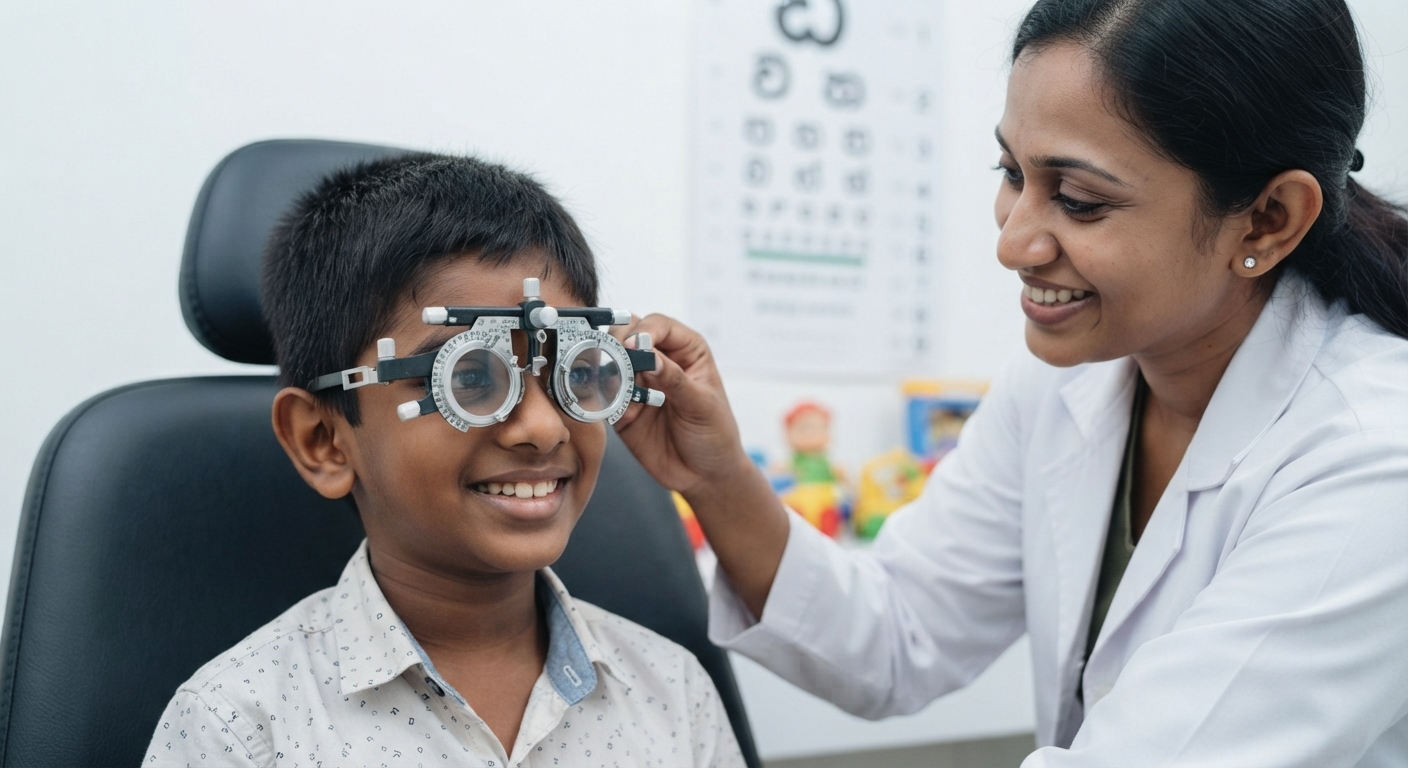
A child eye test in Sri Lanka takes very little time and is completely painless. It is also the only reliable way to find the vision problems kids never think to mention, because a child who has always seen this way assumes everyone does.
Even with no symptoms, a child should have a proper eye examination:
A children’s eye examination is not a quick chart reading. Rather, it checks focusing, eye alignment, coordination and eye health — things a school screening does not cover.
Our paediatric eye surgeons see children of all ages, and they keep the examination quick and unintimidating.
Screens are part of childhood now, and banning them is not realistic. What is realistic: get them outdoors daily, build in breaks, and have your child’s eyes checked properly rather than waiting for them to complain.
Vision problems caught early are far easier to correct — and in children, timing genuinely matters.
Mount Lotus Eye & ENT Hospital — Mount Lavinia & Kurunegala. Paediatric eye surgeons available at both hospitals.
📞 Mount Lavinia: 0112 333 444 | Kurunegala: 0372 333 444


Specialist eye, ear, nose and throat care is coming to the Uva Province — the same care that families in Mount Lavinia and Kurunegala already trust, now in your own town.